|
|
|
Spinnaker poles come in two different flavours. Single Ended and Double Ended.
Single Ended Poles
|
|
|
|
|
|
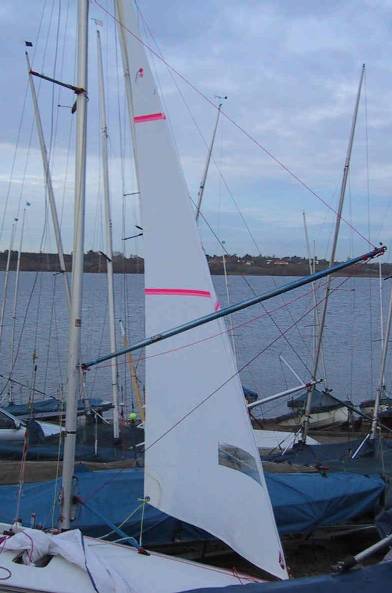
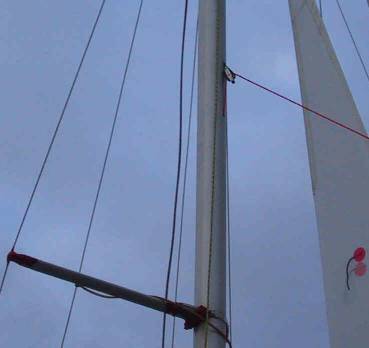
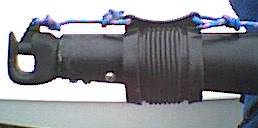
This is a typical 'single ended' pole. Note that the uphaul goes to a pulley on the mast above the spreaders. The height of this pulley is set so
that the pole lies level with the boom when stowed, but sets at a sensible kite flying height when extended.
This means you don't have to mess about with the pole height adjustment every time you launch or retrieve the pole.
It is called Single Ended because the kite can only be clipped on at one end (the end where the uphaul and downhaul are).
The uphaul and downhaul are tied or clipped onto the pole.
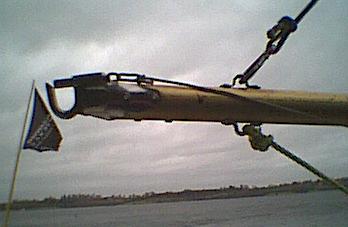
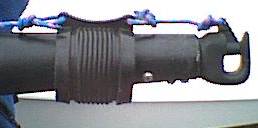
It is a matter of personal preference whether the clips on the ends of the pole face downwards, as in this shot...
|
|
|
|
|
|
|
A close-up of the uphaul pulley, which attaches to the mast with a simple metal eye-strap. The uphaul on this boat runs into the mast through a slot
hole a short distance below the pulley. This weakens the mast (marginally) - on most boats this runs down the outside of the mast and enters at the lower through-mast pulley (intended for a
DEP).
|
|
|
|
|
Double Ended Poles
The point about these is that you can clip either end onto the kite. This makes for faster kite gybing, at a small expense in the speed of launching and
retrieving the pole. The pole uphaul and downhaul lines have to connect to the centre of the pole to allow the ends to be interchangable, so we use a ramp.
|
|
|
|
|
|
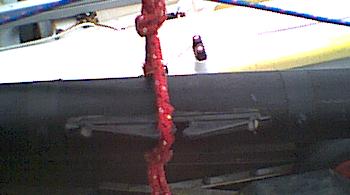
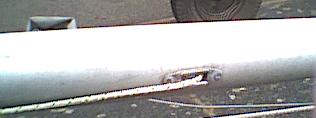
The ramp is supposed to engage with the rope loop (which is joined to the pole uphaul and downhaul lines) when you push the pole out. The ramp is
screwed to the side of the pole with respect to the jaws (which face up or down). You have to get your loop right, so it catches on the ramp easily when launching the pole, but also so a 90o twist of the pole will allow the ramp to pass through the loop for retrieval.
|
|
|
|
|
 |
|
|
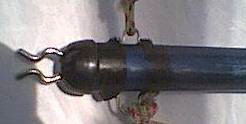
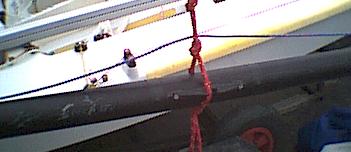
Note that the line which joins the jaws together runs outside the rope loop. This stops the loop from sliding off the end of the pole, which in turn
stops the pole from falling in the water and sinking. This is therefore a good thing.
|
|
|
|
|
|
|
Most masts arrive pre-cut with a pulley slot below the shrouds suitable for a Double Ended pole. If rigging a single ended pole, the pulley which lives in this slot needs to be turned upside down or taken out altogether.
|
|
|
|
Shot of mast pulley for Double Ended Pole >>
|
|
|
|
|
|
The pole uphaul line for both types of pole runs up from the pole to a pulley on the mast, then back down (inside or outside) to a block at the abse of the
mast. From here, it runs back to a cleat on the centreboard case which allows for pole height adjustment. Pull for higher, let a bit out for lower.
The pole downhaul is a bit trickier. This runs down from the pole through an eye on the strut (if you have one), then through the foredeck or the front of the
mast gate, to a pulley block at the base of the mast.
|
|
|
|
|
|
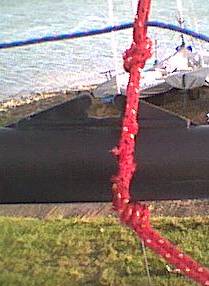
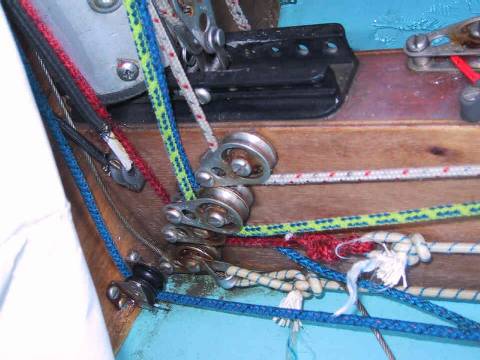
Uphaul and downhaul could be any of these really. In this shot, the pole downhaul is the red rope - note the elastic tied on and the fat knot in the
red rope. The pole is extended and the elastic is fairly tight. The pole cannot go much higher before the knot hits the pulley.
|
|
|
|
|
The elastic runs to the transom of the boat along the spine, and then returns to the front - you can see where it ties off below the red rope. The idea is that
when the pole is brought back in to lie along the boom, the elastic takes up the slack in the red rope. When the pole is extended, uphaul will allow height adjustment by working against the elastic. The
knot in the red rope will stop the pole from 'skying' - that is from stretching the elastic madly and going higher than you wanted. This can happen in a serious blow. You need to position your knot very
carefully, so it engages with the pulley at the point of maximum desirable pole height.
|
|
|